
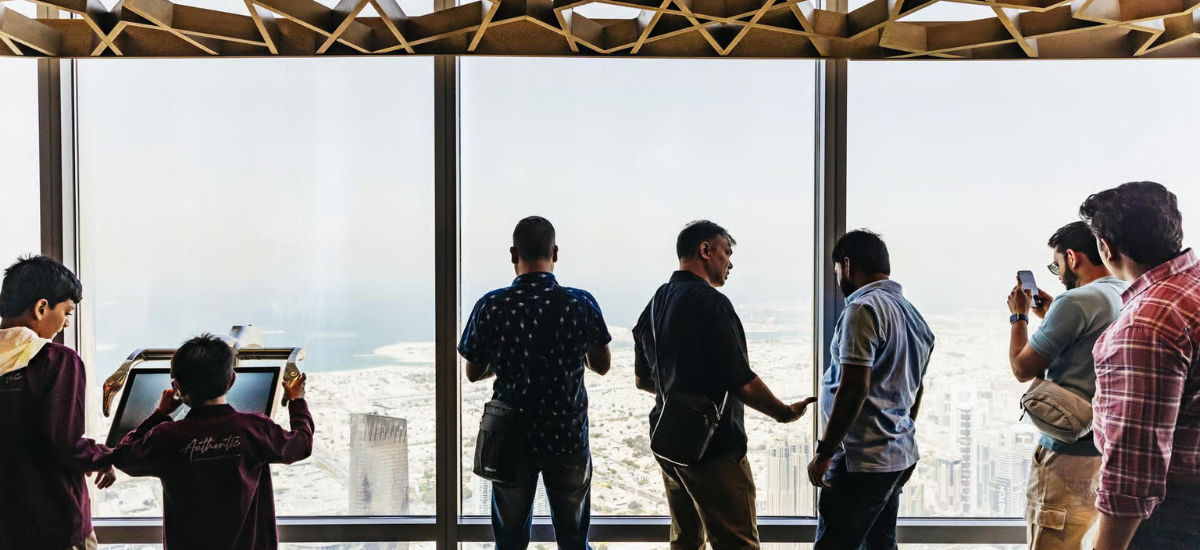
You’re standing in Dubai Mall, and somewhere above the shoe stores and the aquarium, a building is quietly holding the record for tallest structure ever made. You bought a ticket because everyone says you have to. But nobody’s actually told you what happens next — where you check in, what the elevator ride feels like, or whether the view is worth rearranging your itinerary around.
That’s the gap this guide fills. If you’re trying to figure out what to expect at Burj Khalifa before you commit to a ticket, here’s the visit laid out the way it actually unfolds — from finding the entrance to walking back out onto the mall floor.
What Happens During a Burj Khalifa Visit?
A Burj Khalifa visit follows a fixed sequence no matter which ticket you buy — only the levels you reach at the end change.
- Arrive at Dubai Mall and find the dedicated Burj Khalifa/At the Top entrance.
- Check in with your ticket confirmation (usually a QR code) and photo ID.
- Pass through airport-style security screening.
- Wait in a themed lobby until your timed entry slot is called.
- Board a high-speed elevator for the ride up.
- Step out onto your first observation level (124, or 148 first on SKY tickets).
- Explore the indoor and outdoor viewing areas.
- Check out interactive exhibits, telescopes, and photo stations.
- Depending on your ticket, move on to additional levels (125 and/or 148).
- Take the elevator back down and exit into Dubai Mall.
That’s the whole arc. Now let’s slow down, because the details are where people either love this experience or feel like they rushed it.
Check-In and Security — What Happens Before You Go Up?
The entrance isn’t obvious from inside Dubai Mall. It’s a dedicated area away from the main shopping crowds, and depending on which door you use, you might walk past several unrelated stores before spotting the signage. Coming from the Dubai Mall/Burj Khalifa metro station, plan on roughly 15 to 20 minutes of walking through mall corridors. A taxi or rideshare dropped near the entrance on Sheikh Mohammed bin Rashid Boulevard tends to be faster.
Check-in itself is simple: show your ticket confirmation and a passport or ID, and staff point you toward security. The screening feels like an airport checkpoint — bags through a scanner, a walk through a metal detector. It’s quick, but not skippable, so don’t cut your arrival time too close.
Tickets come with a specific entry window, not an open-ended pass. Sunset slots sell out first, and showing up outside your window can mean waiting for the next opening rather than walking straight through. Worth checking Burj Khalifa opening hours before you plan the rest of your day around it.
After security, you’ll pass through a themed waiting area where staff typically call groups forward by entry time. Procedures shift occasionally, so treat this as the general pattern, and double-check your [ Burj Khalifa tickets confirmation for anything specific to your booking.
What Is the Burj Khalifa Elevator Experience Like?
This is the part people remember almost as much as the view itself. The elevators are genuinely fast — you’re covering more than 100 floors in under a minute, and you’ll feel it more in your ears than your stomach. It’s smooth, not a stomach-drop ride, but the speed is noticeable in a way a normal elevator never is.
While you’re moving, the cabin runs a short multimedia presentation, often built around famous skylines and tall buildings around the world, so the ride doesn’t feel like dead time.
What makes it different isn’t just the speed — it’s the compression of scale. You get on surrounded by mall shoppers, and less than a minute later the doors open onto a view that stretches to the horizon. There’s no theatrical countdown or fanfare; it’s understated, which honestly makes the moment the doors open feel bigger by contrast.
What Is Level 124 Like?
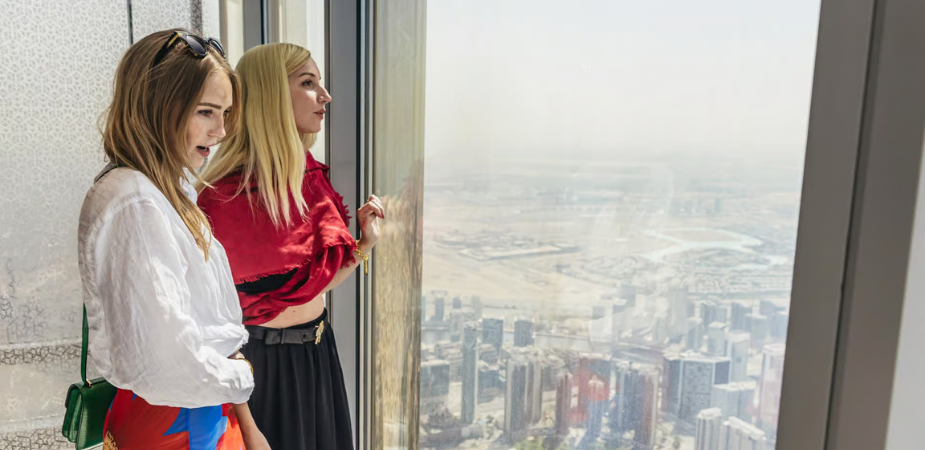
Level 124 is where nearly every visit begins, and it’s the level most people picture as “the observation deck.” It sits at 452 meters and carries the most energy of the three — expect it to be the busiest, especially around sunset.
You’ll find a mix of indoor floor-to-ceiling glass and a genuine outdoor terrace, so you can step outside and feel the air rather than viewing everything through glass. High-powered telescopes let you zoom in on specific landmarks or watch traffic crawl along Sheikh Zayed Road from an absurd height, and interactive displays walk through how the building was designed and built.
This is also the easiest level for a clean photo, since the outdoor terrace avoids glass reflections. If you want one great photo and a solid overview of the city rather than a drawn-out multi-level visit, Level 124 alone does most of the heavy lifting.
What Is Level 125 Like?
Level 125 sits one floor above 124, physically close but noticeably different in feel. Where 124 is bustling and terrace-focused, 125 leans indoor and more design-forward — the interior draws on mashrabiya-style Arabic lattice patterns, and the space feels calmer, partly because it’s smaller and partly because fewer visitors linger there.
Viewing happens through expansive floor-to-ceiling glass rather than open air, which some visitors prefer on a hot afternoon or windy evening. There are also photo-op features here, including green-screen setups that place your shot against a Burj Khalifa backdrop — useful if the light on 124 didn’t cooperate.
If 124 is the raw “look how high up we are” moment, 125 is the more relaxed follow-up: a place to catch your breath and see the same skyline from a slightly different angle without the crowd density below.
What Is Level 148 Like? — At the Top SKY
Level 148 is where the At the Top SKY ticket takes you, and it’s a genuinely different tier, not just a higher floor. You’re now at 555 meters, and visitor numbers on the deck are deliberately limited, which changes the whole atmosphere — more room to actually stand and look instead of jostling for a spot at the railing.
SKY tickets typically include a guided element, refreshments, and access to a private outdoor terrace separate from the one on 124. Some configurations also include a VR experience tied to the building’s upper spire, something you won’t find on the standard levels.
Honest framing: the view is higher, but Dubai’s skyline is already sprawling and slightly hazy on plenty of days from 124, so the visual jump is smaller than the price difference suggests. What you’re really paying for on 148 is atmosphere — fewer people, a slower pace, small touches that make it feel like an occasion. If that matters, it’s a real upgrade. If not, you’re not missing the view, since SKY includes 124 and 125 too.
Can You Go Outside at Burj Khalifa?
Yes — but not on every level. Level 124 has an outdoor observation terrace, so you genuinely step outside into open air. Level 148, included with At the Top SKY, has its own separate outdoor terrace, generally quieter given the lower visitor cap. Level 125, by contrast, is primarily indoor viewing through large glass windows.
So if outdoor access matters to you — for photos without glass glare, or just to feel like you’re actually up there — Level 124 alone covers that on the standard ticket, and Level 148 adds a second, quieter outdoor option on SKY.
What Do You Actually See at Burj Khalifa?
The honest answer: it depends on the day. On a clear one, you’re looking at a genuinely impressive spread — Downtown Dubai directly below, Dubai Mall and the surrounding boulevards, roads fanning out toward the coast, and the Gulf shimmering in the distance. You’ll pick out other landmark towers across the skyline and can often trace Sheikh Zayed Road cutting through the city.
On a hazier day — and Dubai gets its share, especially in summer — that view softens considerably. The far horizon can blur into a golden fog, and landmarks visible one afternoon might be barely a silhouette the next. That’s not a flaw, just desert-city atmospherics driven by heat, humidity, and dust. Nobody can promise a postcard-clear horizon on any given day.
What stays consistent regardless of haze is the scale directly below you — the mall, the boulevard, and the immediate downtown grid stay sharp even when the far distance softens.
Burj Khalifa Views by Direction
The building sits at the edge of Downtown Dubai, so what you see shifts depending on which side of the deck you’re standing on.
| Direction | What You May See | Best For |
|---|---|---|
| Downtown / city core | Dubai Mall rooftop, Downtown towers, the boulevard grid | Photos of density and skyline scale |
| Toward the Gulf | Coastal towers, the Gulf waterline on clearer days | Sunset light and water reflections |
| Desert side | Open, flatter terrain stretching to the horizon | Seeing how abruptly the city ends against the desert |
| Broader skyline | Scattered landmark towers across Dubai | Spotting other buildings you recognize |
Walk the full loop of whichever deck you’re on rather than planting yourself at one railing — the downtown-facing and desert-facing sides look more different than most first-timers expect.
Indoor vs Outdoor Observation Deck
| Feature | Indoor | Outdoor |
|---|---|---|
| Comfort | Climate-controlled | Exposed to outside temperature and wind |
| Photography | Some glass reflection to manage | Cleaner shots, nothing in the way |
| Weather exposure | None | Full sun, heat, or wind depending on time of day |
| Experience | Calmer, easier with kids | More immersive, feels like “being up there” |
| Best for | Hot afternoons, families, glare-sensitive photographers | Sunset visits, photographers, the full sensory moment |
If you only have time for one style, outdoor on Level 124 gives you the more memorable version. If comfort matters more — say, a midday visit in July — the indoor viewing on Level 125 isn’t a downgrade, just a different way to see the same city.
Is Level 148 Worth It?
There’s no single right answer, but here’s how to think about it honestly.
What you’re paying for isn’t a dramatically different view — it’s a calmer, less crowded, more curated version of the same skyline, plus small extras like refreshments and a guided element. The jump from 124’s roughly 452 meters to 148’s 555 meters is real, but on a hazy day the visual difference can be subtle. On a clear day, the extra height adds a noticeably wider perspective, and the smaller crowd makes it easier to actually enjoy standing there.
Consider paying more if you’re marking an anniversary, want Dubai’s single biggest “wow” moment without compromise, or crowded decks genuinely stress you out. If Burj Khalifa is the one splurge of your trip, this is where it shows.
You’re probably fine with the standard levels if you’re budget-conscious, traveling with kids who won’t sit through a guided element, or just want a solid view and good photos. Levels 124 and 125 deliver the core experience — height, skyline, real outdoor access — without the premium price.
If you’re still weighing it, At the Top vs SKY breaks down the ticket differences in more detail. When you’re ready, you can compare Burj Khalifa ticket options and pick the tier that matches how you actually want to spend that hour.
How Long Does the Burj Khalifa Experience Take?
Plan for 90 minutes to two hours, door to door, depending on your ticket and how long you like to linger: 15 to 20 minutes from the mall entrance or metro to the ticket area, 10 to 20 minutes for check-in and security, possible extra wait time, then 45 minutes to an hour on the decks themselves.
Standard At the Top visits (Levels 124 and 125) run on the shorter end. SKY tickets, with the added Level 148 and its slower pace, often stretch closer to two hours. Crowds matter too — a Friday sunset slot moves slower than a quiet Tuesday morning. If photography matters to you, pad in an extra 15 to 20 minutes.
What Is the Burj Khalifa Experience Like for Different Travelers?
For First-Time Visitors
Prioritize timing over ticket tier. Sunset slots deliver the most dramatic transition from daylight skyline to lit-up nightscape, but they book out first. Checking best time to visit Burj Khalifa before locking in a slot shapes the experience more than upgrading to SKY does.
For Couples
For a special occasion, Level 148’s smaller crowds and calmer pace make it easier to enjoy the moment together. For a regular evening out, a sunset slot on the standard ticket covers the mood just fine.
For Families
Factor in patience, not just price. Young kids may lose interest before the visit’s over, so the shorter, less structured standard experience is usually more forgiving. Indoor viewing on 125 also works as a break spot if the heat on 124 gets to be too much.
For Photographers
Outdoor access and light matter more than which level you’re on. Level 124’s terrace gives the cleanest angles, and the last hour before sunset gives the best light. Overcast or hazy days mute shots regardless of level, so keep an eye on forecasted visibility.
For Budget Travelers
The standard ticket genuinely covers the core experience — height, skyline, real outdoor access, telescopes, two full levels. You’re not getting a diminished Burj Khalifa by skipping SKY, just the same view with a busier deck and fewer extras.
How Does Burj Khalifa Compare With Other Dubai Observation Decks?
Dubai has other tall-building viewpoints, but none currently match Burj Khalifa on height or landmark status — it’s still the tallest structure on the planet, and that shapes the whole experience, from elevator speed to the sense of scale once you’re up there. Other decks tend to feel more relaxed and less ticketed, sometimes with skyline views that include Burj Khalifa itself in the frame — altitude and bragging rights versus crowds and cost. If you’re deciding how it fits into a broader itinerary, Burj Khalifa vs Other Dubai Observation Decks lays out the comparison.
Tips to Get More From Your Burj Khalifa Experience
Double-check your entry time, included levels, and entrance location a day or two ahead, not the morning of. Build in buffer time to find the entrance inside Dubai Mall — it’s farther than it looks. Think honestly about whether indoor or outdoor viewing matters more, since that shapes whether Level 124 alone is enough or 125’s calmer indoor space is worth adding.
Don’t assume every ticket includes the same levels — confirm your specific booking rather than going off a friend’s. Check current Burj Khalifa opening hours before planning your day around your slot. And if the sky looks hazy that morning, don’t panic — the immediate downtown view stays sharp even when the far horizon softens.
Whichever level is right for you, it’s worth locking in your slot ahead of time rather than hoping for a walk-up spot — you can see available Burj Khalifa experiences and pick the tier that fits your trip before sunset slots fill up.
Frequently Asked Questions
Can you go outside at Burj Khalifa?
Yes, on two of the three levels. Level 124 has an outdoor observation terrace, and Level 148 (At the Top SKY) has its own separate terrace. Level 125 is primarily indoor viewing through floor-to-ceiling glass.
Is Level 148 worth it?
It depends on what you value. You get a higher vantage point, a less crowded deck, and small extras like refreshments and a guided element — but the view isn’t dramatically different from Level 124 on a hazy day. It’s most worth it for special occasions or a calmer, less rushed pace.
What do you actually see at Burj Khalifa?
On a clear day: Downtown Dubai below, Dubai Mall and the boulevard, roads fanning toward the coast, the Gulf in the distance, and other landmark towers. Visibility varies with haze and time of day, so the far horizon isn’t always guaranteed to be crystal clear.
What floors can you visit at Burj Khalifa?
Standard At the Top tickets include Levels 124 and 125. At the Top SKY adds Level 148 and still includes 124 and 125. A separate Lounge experience covers Levels 152 through 154.
How long does the Burj Khalifa experience take?
Budget 90 minutes to two hours total, including getting to the entrance, check-in, security, and time on the decks. Standard tickets run shorter; SKY visits typically take longer.