
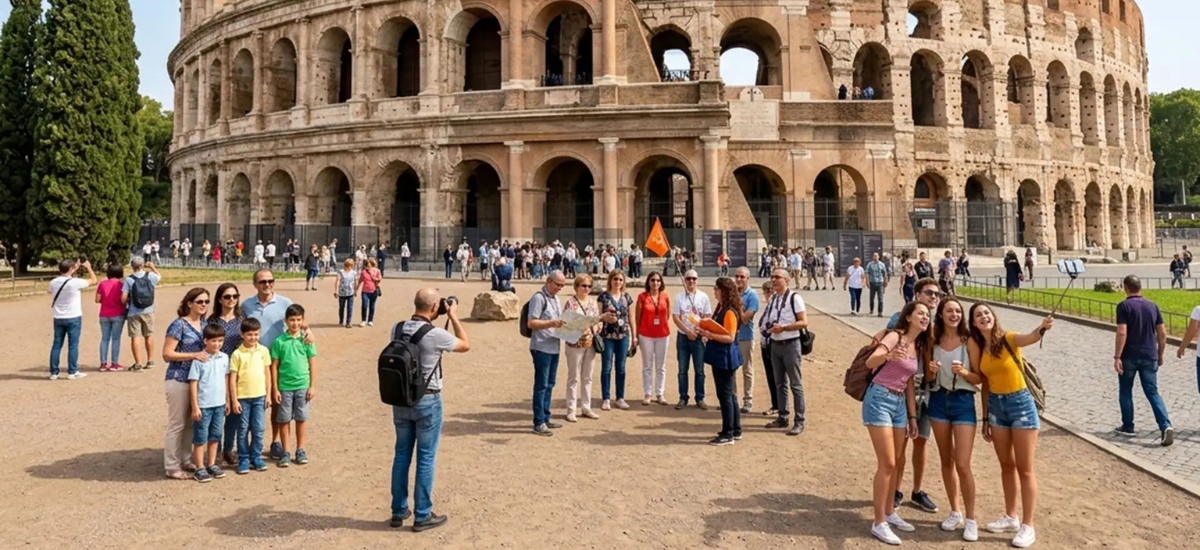
Most people planning a trip to Rome ask the same three questions about the Colosseum. Should you go first thing in the morning, or is it better to leave it until evening? Is July too hot to bother? And will you really end up losing half a day standing in a queue?
Those questions matter more than they sound. Get the timing wrong and you’ll spend your visit shuffling through a wall of tour groups, squinting into a midday sun, wondering why the photos everyone else posts look so much emptier than the scene in front of you. Get it right, and the Colosseum feels like the thing you actually came to Rome for.
Here’s the short version, followed by everything behind it.
The quick answer
Arrive at opening, around 8:30am, or go in the last 90 minutes before last entry. Aim for a weekday — Tuesday to Thursday tend to be calmer than Monday or the weekend. And if you can choose your month, April, May, late September or October give you the best trade-off between decent weather and a site that doesn’t feel like a subway platform at rush hour.
None of that matters, though, if you haven’t booked a timed-entry ticket in advance. That single decision affects your visit more than the time of day does.
Morning or late afternoon: which is actually better
Both work, but they solve different problems.
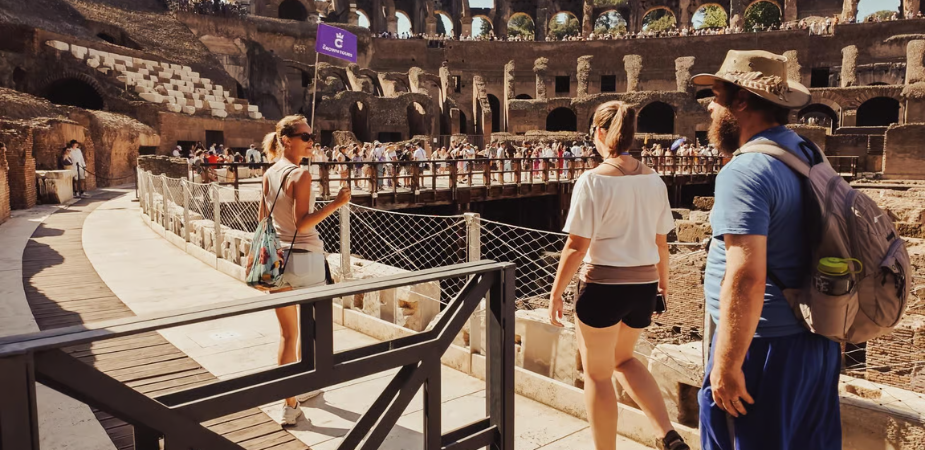
Early morning (8:30–9:30am) gets you in before the big coach tour groups arrive from the cruise ports and out-of-town hotels. The light is soft and low, which is genuinely useful if you want photos without a haze of heat shimmer, and the air is still cool even in summer. The trade-off is that you’re up early on holiday, and the queue at the entrance can still be a scrum in peak season if several tour groups have timed entry at the same slot as you.
Late afternoon, roughly from an hour and a half before last entry, is the quieter option in practice. Day-trippers have moved on to lunch, aperitivo, or the next stop on their itinerary, and the crowds thin out noticeably. In spring and autumn this is also when the light turns gold and falls directly onto the arena floor and the outer arches — it’s the version of the Colosseum you see in the nicest travel photos, and it’s not a coincidence.
Midday, roughly 10am to 2pm, is when to avoid going if you have any choice at all. It’s when independent travellers, school groups and coach tours overlap, and in summer it’s also the hottest part of the day, with very little shade inside the monument itself.
If you’re torn, let the season decide. Go early in summer to dodge the heat. Go late in spring and autumn, when the evening light is the better payoff and the temperature isn’t a factor either way.
Does the day of the week matter?
A little. Tuesday, Wednesday and Thursday are generally the calmest days to visit. Mondays can be busier because some of Rome’s other big sites are closed that day, which pushes more visitors toward the Colosseum instead. Weekends draw a mix of tourists and Roman families, particularly on the first Sunday of the month (more on that below), so if your schedule is flexible, a midweek visit is the easiest single change you can make.
Best months to visit: weather versus crowds
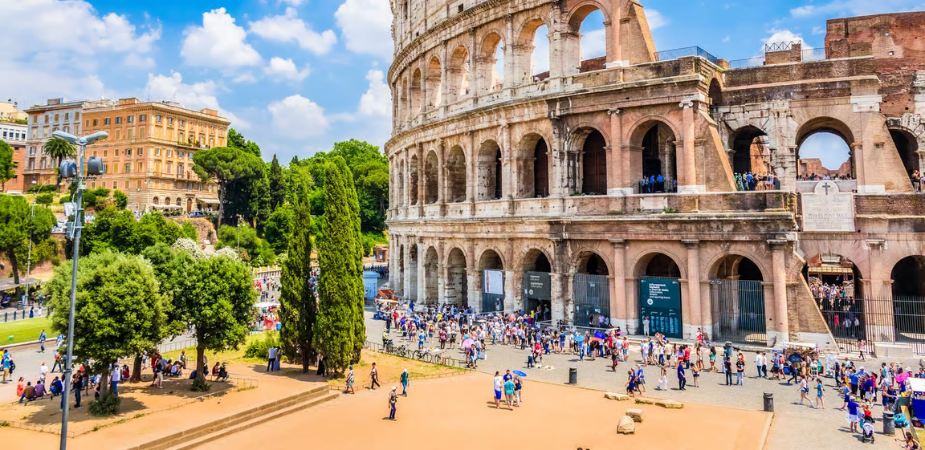
There’s no month where the Colosseum is genuinely quiet — it’s one of the most visited monuments on earth, and it draws a steady stream of visitors most of the year. But some months make the experience noticeably more comfortable than others.
April, May, late September and October — the sweet spot. Daytime temperatures usually sit in a comfortable range for walking around an exposed archaeological site, without the crowds thinning out to the point where prices spike for the shoulder-season demand. October in particular tends to have a softer light in the late afternoon that’s worth planning a visit around if photography matters to you.
June to August — peak season. This is when Rome is at its busiest and its hottest, often uncomfortably so by early afternoon, with little natural shade once you’re inside. If you’re visiting in summer, treat the early-morning or last-entry slots as close to essential rather than optional, and carry more water than you think you’ll need. Guided and premium tour packages also tend to be priced highest in this window, simply because demand is highest.
November to March — the quiet season. This is genuinely the calmest time to visit, with shorter queues and a more relaxed pace inside the site. The trade-off is shorter daylight hours, cooler and occasionally wet weather, and last entry as early as 3:30pm in the depths of winter, which limits your options if you’re travelling on a tight schedule. The Colosseum closes entirely on 25 December and 1 January.
What 2026 opening hours actually are
Hours change through the year, and this is one of the details that catches people out if they’re working from an old blog post or a guidebook printed a couple of years ago. For 2026, the Colosseum’s confirmed opening hours are:
- 29 March – 30 September 2026: open 8:30am, last entry 6:15pm, closes 7:15pm
- 1–24 October 2026: last entry 5:30pm, closes 6:30pm
- 25 October 2026 – 28 February 2027: last entry 3:30pm, closes 4:30pm
Always double-check the live calendar on the official site before you travel, since hours can shift for holidays or special events — but this is the current published schedule for 2026.
Booking tickets: the one decision that matters most
If there’s a single mistake that ruins more Colosseum visits than a bad time-of-day choice, it’s assuming you can turn up and buy a ticket at the gate. You can’t rely on that. Entry is by timed, reserved slot, and popular time windows in spring and summer sell out well in advance. Bookings open 30 days ahead through the official ticketing platform, ticketing.colosseo.it, and that’s where slots genuinely run out first — not at a resale site.
For 2026, standard pricing for the combined ticket (Colosseum, Roman Forum and Palatine Hill, valid for 24 hours) is:
- Adults: €18
- EU citizens aged 18–25: €2
- EU citizens under 18, and all children under 6 regardless of nationality: free (still requires a booked slot)
- Visitors with disabilities and one accompanying carer also enter free, with documentation
That standard ticket covers the Colosseum’s first and second levels plus the Roman Forum and Palatine Hill. Premium add-ons — the arena floor, the underground chambers, or the upper attic levels — are ticketed separately, currently around €22 for adults, and these do need to be booked as their own timed slot alongside your standard entry.
Free entry days: the Colosseum offers free admission on the first Sunday of every month, plus a handful of Italian national dates (25 April, 2 June and 4 November in 2026). You still need to reserve a free timed slot in advance — walking up without one doesn’t guarantee entry — and free admission only covers the standard areas, not the arena floor or underground. Worth knowing if you’re on a budget, but be aware these are also the single busiest days to visit, so it’s a trade-off between cost and crowds rather than a genuine shortcut.
One more practical point: bring photo ID that matches the name on your ticket. Staff do check, and a mismatched booking can mean being turned away at the gate.
Is it worth paying for a guided or skip-the-line tour?
Not everyone needs one. If you’re comfortable reading a bit ahead of time and don’t mind self-guiding with an audio app, the standard ticket gives you full access to the Colosseum, Forum and Palatine Hill, and that’s a complete visit in its own right.
Where a guided option earns its price is context. The Colosseum without a guide is an extraordinary space, but a lot of what made it functional — the trapdoors, the pulley systems, the seating arranged strictly by class — isn’t obvious just from walking through it. A licensed guide fills in that picture in a way that’s hard to get from a plaque. This guided tour of the Colosseum, Roman Forum and Palatine Hill covers all three sites with a dedicated guide, and it’s a solid option if you’d rather not plan the logistics of separate entry slots yourself.
If you’ve already seen the main site on a previous trip, or you want to go further than the standard ticket allows, the arena floor and underground chambers are the next step. Standing where the gladiators actually stood, with the crowd noise well above you, is a different experience to seeing it from the stands. This underground and arena floor tour includes that access with a guide, and it needs booking further ahead than standard entry, since availability is more limited.
Either way, book directly rather than leaving it to chance at the gate — this is one of the few Rome attractions where “we’ll sort it out when we get there” genuinely doesn’t work.
Visiting with kids
The Colosseum can be a lot for younger children — uneven stone, limited shade, and long enough queues to test anyone’s patience. A few things help: go at opening or in the last couple of hours of the day, when the heat and crowd pressure are both lower; bring more water than feels necessary; and treat the Roman Forum and Palatine Hill as places to let kids run around a bit more freely, since they’re more open than the Colosseum itself. EU children under 18 and all children under 6 enter free, but they still need their own booked slot.
How long you actually need
For the Colosseum on its own, without a guide, most visitors need somewhere between 45 minutes and an hour. If you’re doing the full combined ticket — Colosseum, Forum and Palatine Hill — set aside closer to three hours, more if it’s a guided visit or you’re stopping often for photos or shade. The Forum and Palatine Hill genuinely take longer to explore properly than people expect; it’s easy to rush them because the Colosseum is the name everyone knows, but there’s a lot of ground to cover once you’re there.
Practical tips worth knowing before you go
Wear shoes you can walk in for a few hours on uneven stone — this isn’t the place for anything without proper support. Security screening is airport-style, so avoid bringing large bags, and glass bottles aren’t allowed inside. There’s very little shade once you’re through the entrance, so a hat and sun protection matter more than they might elsewhere in the city, particularly if you’re visiting between May and September.
Frequently asked questions:-
What is the least crowded time to visit the Colosseum?
Early morning at opening, or the last 90 minutes before last entry, on a weekday between Tuesday and Thursday. Combine that with a shoulder-season month — April, May, late September or October — for the calmest overall experience.
What is the best month to visit the Colosseum for good weather without huge crowds?
April, May, and late September through October offer the best balance. Summer is hotter and busier; winter is quieter but colder, with shorter opening hours.
How far in advance should I book Colosseum tickets?
Booking opens 30 days ahead on the official site. For summer visits, book as close to that 30-day mark as you can — popular time slots do sell out. In the quieter winter months you generally have more flexibility, but booking ahead is still worth doing.
Are there night tours of the Colosseum?
Evening and night access does run at points during the year, though scheduling varies and it isn’t available every month. Check current availability on the official booking site or through a licensed tour operator closer to your travel dates, since this changes more than the standard daytime hours do.
How long should I plan to spend at the Colosseum?
About 45 minutes to an hour for the Colosseum alone. Add the Roman Forum and Palatine Hill, both included on the standard ticket, and plan for closer to three hours total.
Is the Colosseum free on any day?
Yes — the first Sunday of every month, plus a few Italian national dates through the year. You still need a booked free timed slot, and these are also the busiest days to visit, so it’s worth deciding whether the saving is worth the extra crowd.
Before you go
There’s no single perfect hour that guarantees an empty Colosseum — it’s too significant a site for that, and it draws visitors year-round. What actually makes the difference is stacking a few decisions in your favour: an early or late time slot, a weekday if your schedule allows it, a shoulder-season month if you’re choosing when to travel at all, and a ticket booked well before you land in Rome. Get those right and the gap between “packed monument” and “the Colosseum you pictured” comes down almost entirely to planning, not luck.