
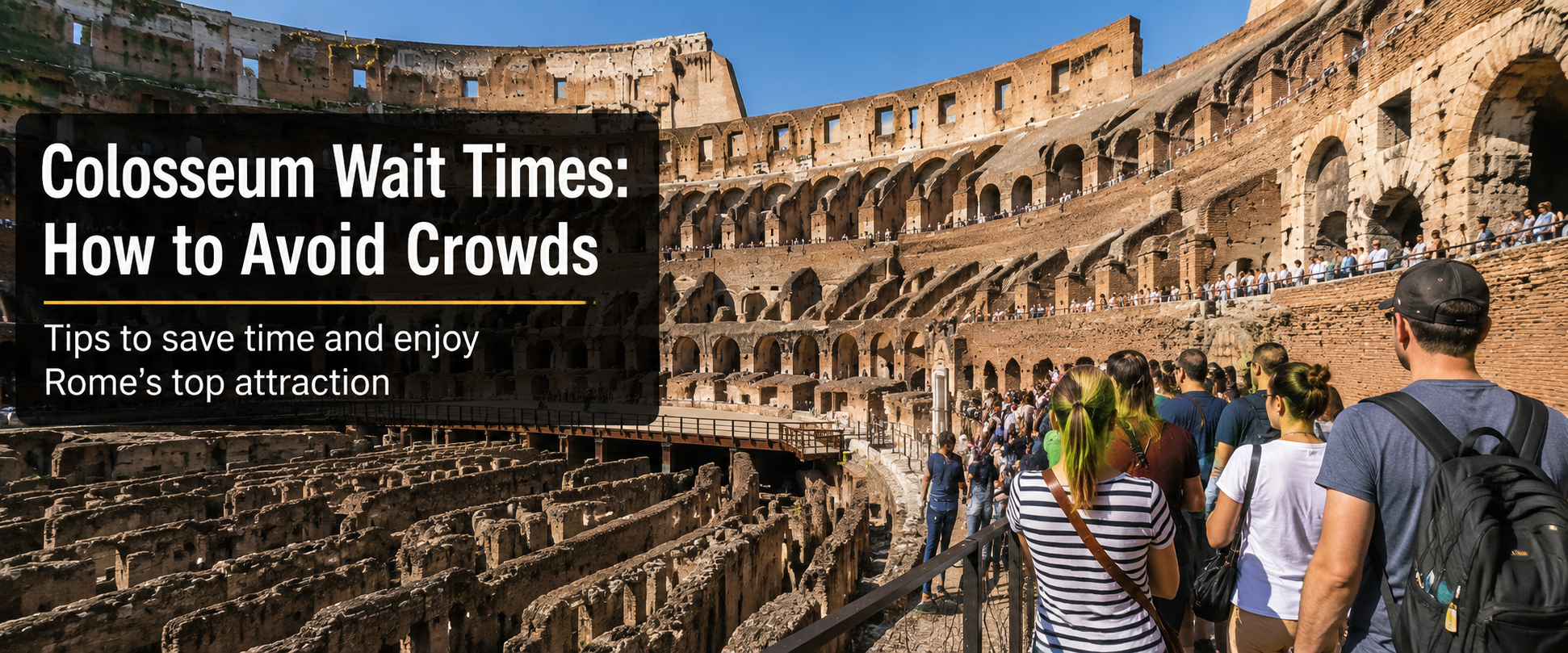
Colosseum wait times can turn a dream morning into a sunburned nightmare in about ninety minutes flat. Picture this: it’s 11:40 on a July morning, the sun is doing something borderline hostile to the back of your neck, and the queue outside the Colosseum has folded back on itself twice. Somewhere near the front, a tour guide is holding up a laminated sign shaped like a sunflower. You still have ninety minutes to go. Nobody in that line planned for this — they just didn’t know the schedule they’d accidentally booked themselves into.
That line is avoidable. Not through luck, and not by showing up “early-ish” and hoping. Colosseum wait times follow one of the most predictable patterns in Rome once you understand why the queue forms in the first place — and once you know the exact hours to sidestep.
Why the Line Forms in the First Place
It helps to know that the wait outside the Colosseum isn’t really one line — it’s three problems stacked on top of each other.
- Volume. Around 6.5 million people pass through the Colosseum every year, and a huge share of them are trying to see it inside the same six-hour window each day.
- Timed-entry gates. Every ticket is tied to a specific entry slot, but slots bunch up around mid-morning because that’s when most flights have landed, hotel breakfasts have ended, and everyone’s itinerary says “Colosseum, then Forum, then lunch.”
- Airport-style security. Bags get scanned, pockets get emptied, and this single checkpoint feeds every visitor regardless of ticket type — which is exactly why “skip-the-line” doesn’t mean “skip the checkpoint” (more on that below).
None of this is random. It’s a predictable crush that peaks and drains on a schedule you can actually plan around.
How Long Is the Wait, Really?
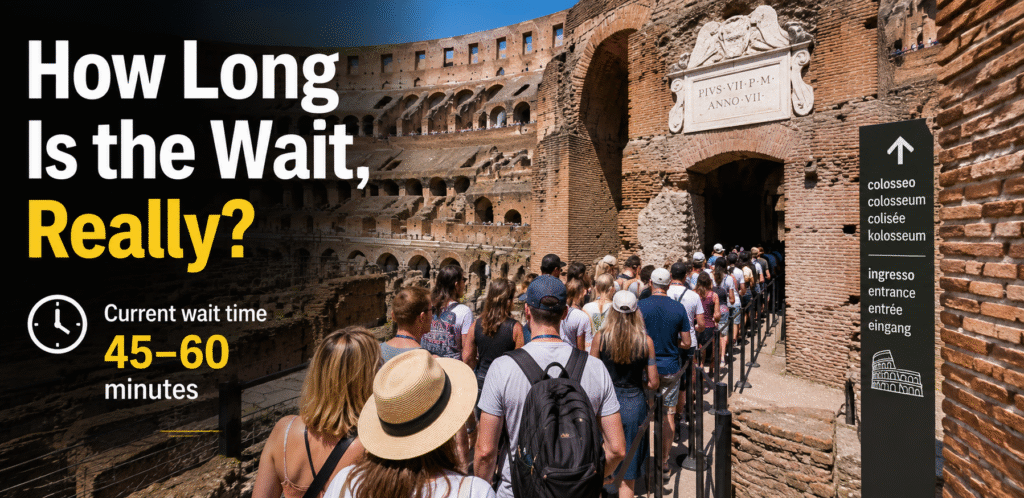
At the standard ticket booth in the middle of a summer day, walk-up visitors regularly face 60 to 120 minutes just to get through security and ticket control — before they’ve even reached the arena floor. In shoulder season (spring and autumn), that drops to roughly 30–60 minutes. In deep winter, on a quiet weekday, you might wait as little as 10 minutes.
The catch: those numbers are for people buying tickets on the spot. Anyone who pre-books a timed slot cuts straight past the ticket queue and joins a much shorter security line — usually under 15 minutes, any season.
Best (and Worst) Time Slots for Crowds
Not all hours are created equal. Here’s how a typical day breaks down:
- 8:30–9:30 am (opening hour): The single best window of the day. Tour buses haven’t arrived yet, and the site feels almost calm.
- 10:30 am–2:30 pm: Peak chaos. Every group tour, cruise excursion, and day-tripper converges here. This is when hour-plus waits happen.
- After 4:00 pm: A quieter second wind. Big groups have moved on to the Forum or dinner, and the light turns gorgeous for photos.
- The first Sunday of the month (free admission day): Skip it entirely if crowds bother you — this is consistently the single busiest day of the month, with lines that can snake well past the metro stop.
Is the Colosseum busy in summer? Yes — June through August is the highest-crowd stretch of the year, driven by school holidays and peak tourist season. Combine that with Rome’s brutal midday heat and the 10:30–2:30 window becomes genuinely miserable to stand in. If summer is your only option, treat a pre-booked early slot as non-negotiable rather than a nice-to-have.
Is the Colosseum less crowded in winter? Considerably. December through February sees the lowest visitor numbers of the year, with weekday waits sometimes as short as 10–15 minutes even without a pre-booked slot. You’ll trade a bit of warmth for a site that feels almost yours — and honestly, the Colosseum under a grey Roman sky has its own kind of drama.
How Far in Advance Should You Book?
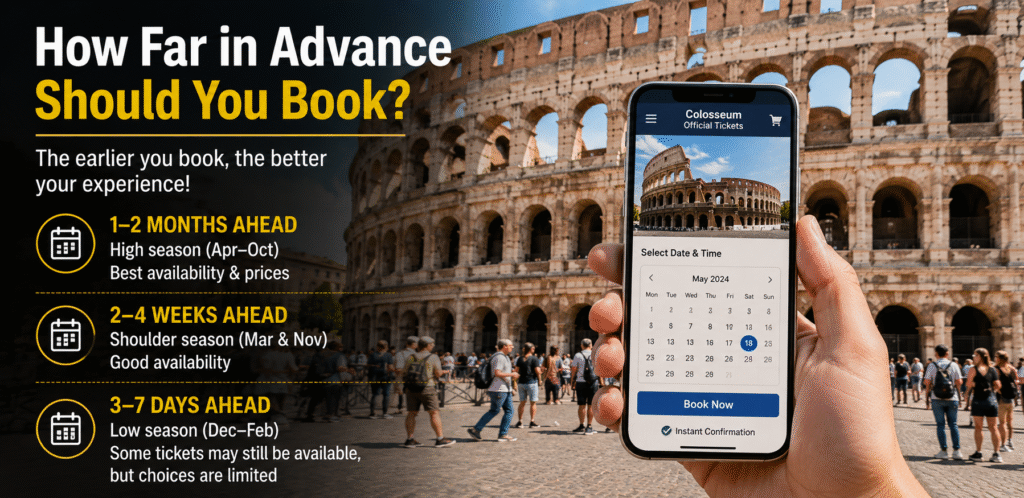
Standard entry tickets can be booked weeks out and often stay available closer to your date, but they still sell through fast in peak months — booking 2–3 weeks ahead is a safe habit.
Arena floor and underground (Hypogeum) access work differently: those slots open exactly 30 days before the visit date and are released in limited batches. Because only a small number of people are allowed on the arena floor or in the underground tunnels per time slot, these tickets can vanish within hours of release during peak season. If a walk in the gladiators’ footsteps is on your list, mark a calendar reminder for the 30-day mark and book the moment slots go live — waiting even a few days can mean the difference between arena access and a sold-out message.
Does Skip-the-Line Actually Skip the Line?
Mostly, yes — with one honest caveat. A skip-the-line ticket removes you from the ticket-purchase queue (the longest, slowest part of the wait) and lets you join a dedicated entry lane. What it can’t do is skip airport-style security, since that checkpoint applies to every visitor regardless of ticket type. In practice, that means the difference between waiting 90 minutes and waiting under 10.
Here’s how the main entry options stack up:
Fast-Track Priority Entry — the simplest fix. You bypass the ticket line entirely and head straight to a dedicated security lane. Ideal if you just want in quickly and plan to explore solo.
Guided Small-Group Tour (Colosseum, Roman Forum & Palatine Hill) — priority entry plus a local guide who actually explains what you’re looking at, in a group small enough that you can hear them.
VIP Underground & Arena Access — the full experience: priority entry, a guide, and access to the arena floor plus the underground Hypogeum tunnels where gladiators and animals once waited their turn. This is the option that needs booking the second the 30-day window opens.
Quick tip: If your travel dates are flexible, checking availability a full month out — right when arena and underground slots first release — gives you the best shot at the exact time you want, instead of settling for whatever’s left.
For the full breakdown of every ticket type, combo passes, and which one fits your itinerary, our complete Colosseum tickets guide walks through it step by step.
How Early Should I Arrive at the Colosseum?
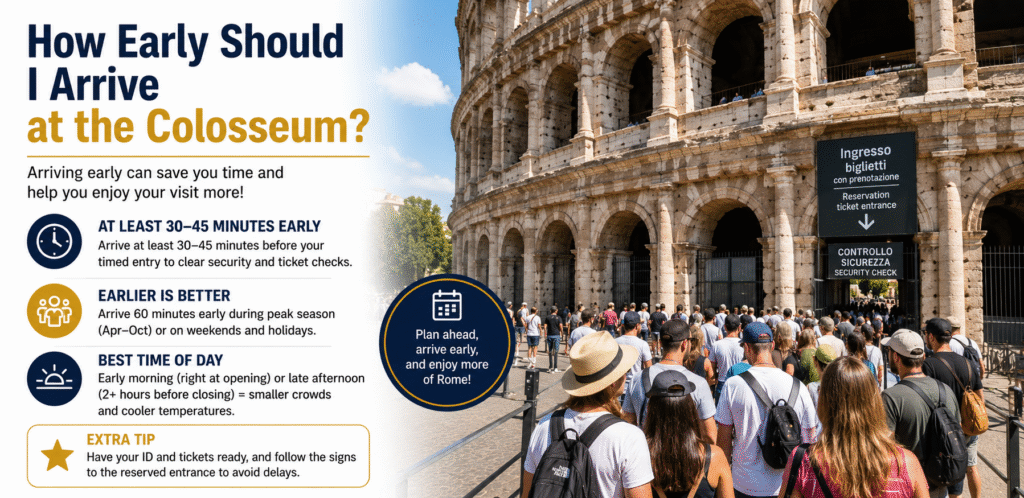
Even with a pre-booked, skip-the-line ticket in hand, arrive 15–30 minutes before your timed slot — not after it starts. Security screening still applies to everyone, staff won’t hold your exact slot indefinitely if there’s a backlog, and Rome’s public transport has a way of running just late enough to make you sweat. If you’re booked for the opening slot, arriving 20 minutes early also means you’re one of the first bodies through the gate, which is worth more than any ticket type when it comes to getting photos without a stranger’s elbow in frame.
One more logistics note: the Colosseum shares its archaeological park with the Roman Forum and Palatine Hill on the same combined ticket, so budget your morning accordingly rather than rushing all three before lunch.
FAQ:-
Is the Colosseum less crowded in winter?
Yes. December to February brings the lowest visitor numbers of the year, with weekday waits sometimes under 15 minutes even for walk-up tickets — though opening hours run shorter, so double-check the season’s closing time before you plan your day.
How long is the wait at the Colosseum?
It depends entirely on your ticket and timing. Walk-up visitors in peak summer midday can wait 60–120 minutes. Pre-booked, skip-the-line visitors typically clear security in under 15 minutes in any season.
Does skip-the-line actually skip the line?
It skips the ticket-purchase queue, which is the slowest part of the process, and moves you into a dedicated priority lane. Every visitor still passes through the same security check, so it isn’t a completely line-free entry — just a dramatically shorter one.
How early should I arrive at the Colosseum?
Arrive 15–30 minutes before your booked entry slot, even with skip-the-line tickets. If you’re visiting without a pre-booked ticket, arrive at least 30–45 minutes before opening to beat the ticket-line crowd.
Is the Colosseum busy in summer?
Very. June through August is the highest-crowd season, with the 10:30 am–2:30 pm window regularly producing hour-plus waits. Booking an early-morning slot in advance matters more in summer than at any other time of year.