
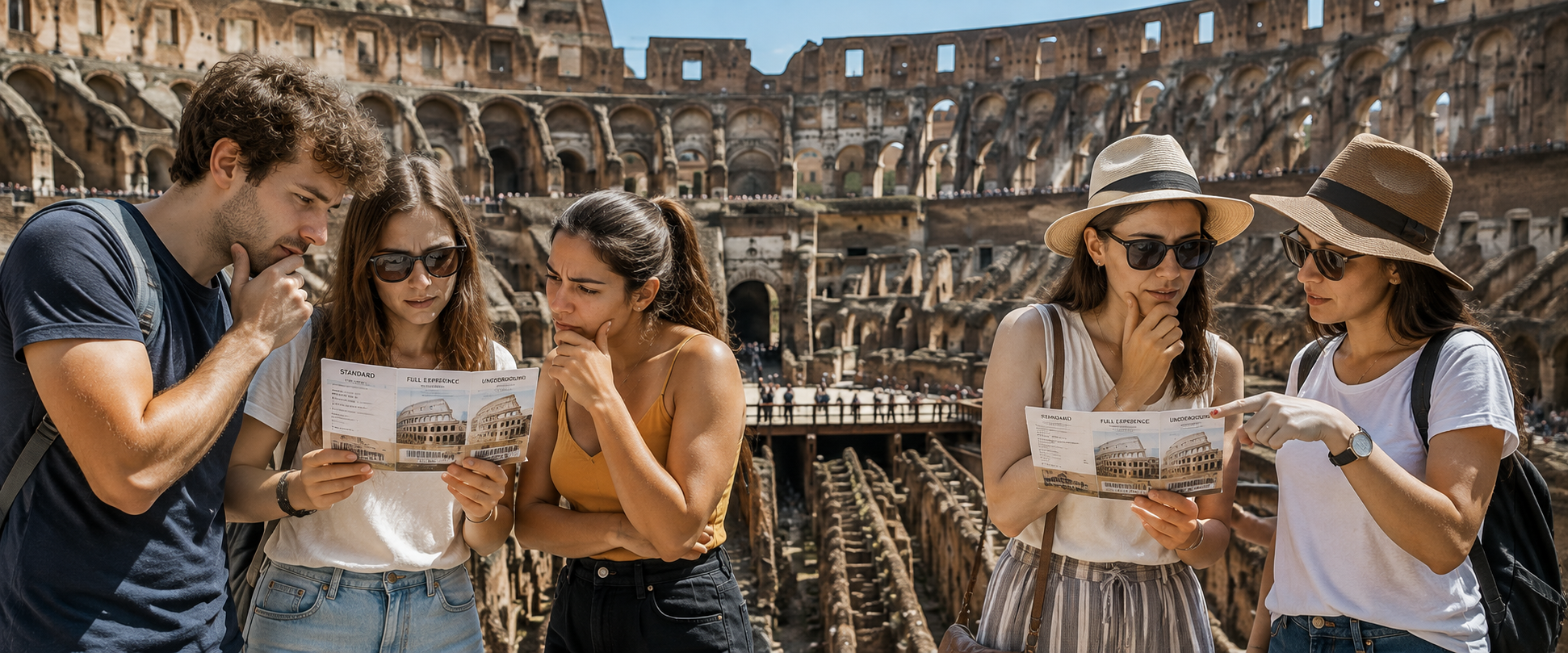
I’ve bought all four tiers on different trips, stood in the wrong line once because I picked the cheapest option without reading the fine print, and watched a family in front of me get turned away because their “guided tour” ticket didn’t include the entry slot they thought it did. So let’s skip that whole mess. Here’s the honest breakdown, sorted by the kind of traveler you actually are.
Why There Are So Many Ticket Options in the First Place
The Colosseum limits how many people can be inside at once, which is why every ticket is tied to a specific entry window. On top of that, three areas require separate access: the main structure, the arena floor (where the fighting actually happened, now rebuilt over the old wooden platform), and the underground hypogeum, the tunnel network where gladiators and animals waited before a fight. Combine that with the neighboring Roman Forum and Palatine Hill — included in almost every ticket, whether you visit them or not — and you get dozens of listings that are really just four core products wearing different outfits.
The Four Tiers, Translated
- Standard Skip-the-Line Entry — a timed slot into all three sites (Colosseum, Forum, Palatine Hill), usually with an audio guide app. No live human walking you through it.
- Guided Tour — same access, plus an actual guide narrating the history in person, in a small group.
- Arena Floor Tour — you physically stand where the fighters stood, looking up at the stands the way they would have. Guided, smaller groups, sells out faster.
- Underground (Hypogeum) & Full Access — the deepest option. You walk the tunnels below the arena floor, then usually get arena floor and upper-tier access too. The closest thing to time travel this city sells.
Now let’s match these to the person actually booking the trip.
Which Colosseum Ticket to Buy, By Traveler Type
If You’re Watching Every Dollar
You don’t need the theatrics — you need to get inside, see the thing, and put your money toward the trip’s next stop instead. The self-guided audio option covers the Colosseum, Forum, and Palatine Hill in one timed slot, and the app fills in the history so you’re not just staring at old stones wondering what you’re looking at.
- Book at least 3–5 days ahead — even the budget slots vanish during peak season
- Download the audio guide before you leave your hotel Wi-Fi; cell signal inside the ruins is patchy
- Give yourself 2.5–3 hours to actually cover all three sites, not just the Colosseum
If You’re Traveling With Kids
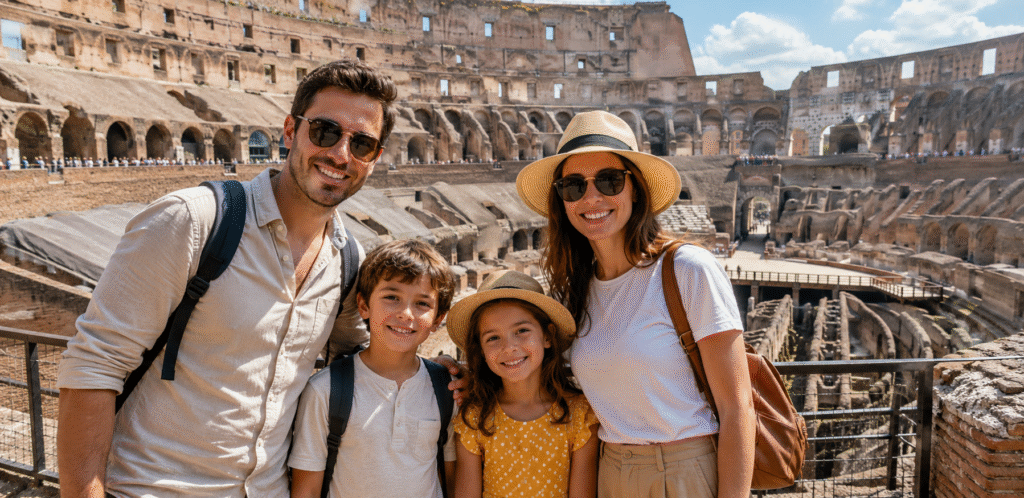
A phone-based audio guide loses a nine-year-old in about four minutes. What keeps kids engaged is a real person pointing at the sand-covered floor and saying “this is where they kept the lions,” then letting the questions fly. The small-group guided tour gives you that without turning the whole morning into a lecture — most run 2.5 hours, which is about the outer limit of a kid’s patience for ancient history before someone needs gelato.
- Aim for a mid-morning slot (10–11 AM) — early enough to beat the worst heat, late enough that nobody’s cranky from a 7 AM wake-up
- Ask if the group size is capped — anything over 25 people means your kids are straining to hear over strangers
- Pack water and a hat regardless of season; there’s very little shade inside
If You Read Every Plaque in Every Museum
Standard entry is going to feel like watching a documentary with the sound off. What you want is underground — the hypogeum tunnels where the actual machinery of the games operated, trapdoors and animal lifts and all. Pair that with arena floor access and you’re seeing the site from three angles most visitors never get: below it, on it, and above it.
- This is the ticket most likely to sell out — book 1–2 weeks ahead in shoulder season, a month out in summer
- Wear real shoes; the underground surfaces are uneven stone, not the flat tourist paths upstairs
- Ask your guide about the elevator systems used to raise animals into the arena — it’s the detail that makes the whole site click
If You’re Building a Portfolio, Not Just Snapshots
The arena floor at golden hour, shot from ground level with the broken stands rising around you, is a different photograph than anything taken from the upper tiers where every other visitor is standing. Fewer people down there too, since it requires its own ticket — meaning fewer strangers wandering into your frame.
- Morning tours (first slot of the day) get better light and thinner crowds than afternoon ones
- Groups are capped smaller on arena floor tours, which matters more for a clean shot than for the history itself
- Bring a wide lens if you have one — the scale is hard to capture otherwise
If This Is Your First Trip to Rome
Go with the guided tour. Not the cheapest option, not the most elaborate one — the middle one, on purpose. A first visit is about context: who built this, why, what happened here for four centuries. A live guide answers the questions you didn’t know you had, in real time, which a phone app simply can’t do. Save the underground and arena floor tiers for a return trip, once you already know the broad strokes and want the details.
- This is the single most-booked tier for a reason — it balances cost, depth, and pace better than any other option
- Confirm your ticket includes the Roman Forum and Palatine Hill in the same visit window; most do, but check before you book
- Arrive 15 minutes before your slot — group tours start on time and won’t wait
If You’ve Already Done the “Standard” Version
You’ve seen the main structure. You know the layout. This trip is about the parts you missed — which almost always means underground, and often means a smaller, more specialized group than the one you joined last time.
- Look for tours capped at 10–15 people; repeat visitors tend to have sharper questions and want more room to ask them
- Consider a sunset or early-morning slot this time — the light (and the crowd) is completely different from the midday visit most first-timers get
- If you skipped the hypogeum last time, that’s your priority now — it’s the one area that changes how the whole site reads
The Recap Table
| Ticket Tier | Best For | What You Get | Group Size | Price |
|---|---|---|---|---|
| Standard Entry + Audio Guide | Budget travelers, solo explorers | Timed entry to Colosseum, Forum & Palatine Hill, self-paced with audio app | Individual | Starting from €29 |
| Guided Tour | First-timers, families | Live guide, skip-the-line entry, small group | Small group | Starting from €49 |
| Arena Floor Tour | Photographers, bucket-listers | Access to the arena floor itself, plus Forum & Palatine Hill, guided | Small group | Starting from €39 |
| Underground & Full Access | History-obsessed, repeat visitors | Hypogeum tunnels, arena floor, Forum & Palatine Hill, expert guide | Small group | Starting from €119 |
Timing Tips Nobody Tells You
- Best months to visit: April, May, September, and October give you daylight without the July/August heat that turns the un-shaded areas into a furnace.
- Best time of day: first entry slot (usually 8:30–9 AM) or the last two slots before closing. Midday, especially between 11 AM and 2 PM, is when every tour group in the city converges at once.
- How far ahead to book: standard entry can sometimes be found within a few days, but arena floor and underground tickets are capped much lower and often sell out one to three weeks in advance during peak months — sometimes further out in summer.
- What “skip the line” actually skips: the general ticket-holder queue, not airport-style security. You’ll still pass through a bag check, so keep it simple.
Frequently Asked Questions:-
Should I buy a standard ticket or a full-experience ticket?
If it’s your first visit and you mainly want context and history without a big spend, the standard guided tour is the better fit. If you want to see the arena floor and the underground tunnels — the parts you can’t picture from photos alone — the full-experience tier is worth the extra cost.
Is the underground tour worth the higher price?
For anyone genuinely curious about how the site functioned — the trapdoors, the animal lifts, the staging areas — yes. It’s the one tier that changes how the whole building reads once you’re back on the ground level looking up. If you’re mainly there for a photo and a general sense of the place, standard or guided entry covers that just fine.
How far in advance should I book Colosseum tickets?
Standard entry can occasionally be booked just a few days out, but anything with arena floor or underground access should be booked one to three weeks ahead, and earlier still if you’re traveling in June, July, or August.
Does every ticket include the Roman Forum and Palatine Hill?
Nearly all of them do, since the three sites share one access system, but double-check the listing before booking — a small number of tickets are Colosseum-only.
What should I bring on the day of my visit?
Comfortable, closed-toe shoes (uneven stone throughout, worse underground), water, a hat or sunscreen since shade is minimal, and the confirmation email or app pulled up on your phone — printed tickets aren’t always necessary but having offline access to your QR code saves a scramble at the gate.